

Ray-Tracing Customized Progressive Lens Calculation: Pupil Diameter Software Optimization
The development of free-form LDS software for ophthalmic lens optical surface calculation has represented one of the most significant technological advances in the optical industry. Modern systems have improved both manufacturing processes and, above all, the optical quality of progressive lenses, thanks to increasingly sophisticated customization and optimization algorithms.
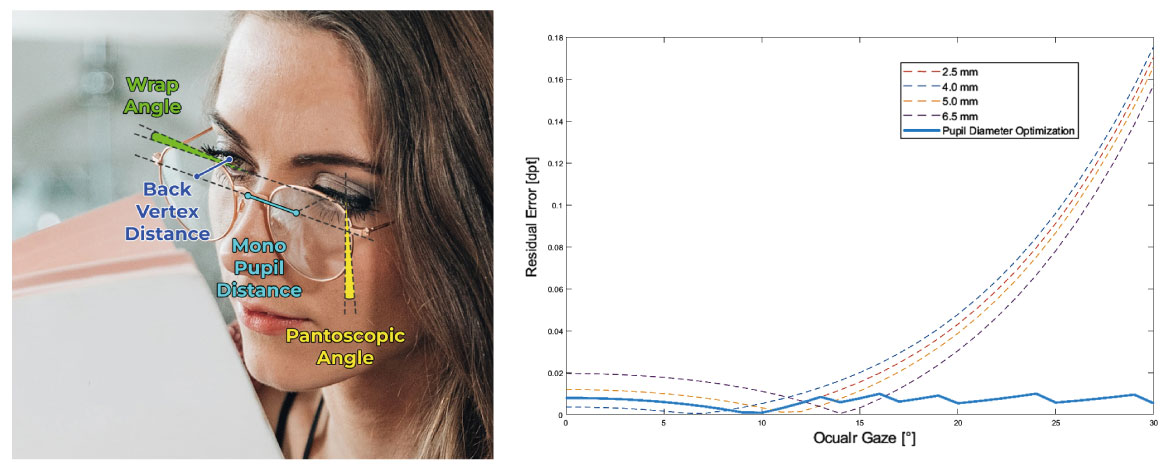
Modern ray-tracing algorithms with wavefront analysis, such as ProCrea WFRT Optimization, make it possible to recalculate the power distribution of progressive addition lenses according to specific position of wear parameters. These include pantoscopic angle, monocular pupil distance, frame wrap angle, fitting height and back vertex distance. The result is a highly customized lens capable of better compensating for oblique aberrations, providing an increased field of view and faster adaptation for the wearer.
However, ProCrea’s research goes a step further by introducing exit pupil diameter as an additional variable in the WFRT simulation. Traditionally, ray-tracing calculations use a fixed pupil diameter of approximately 4 mm. Yet pupil size directly affects the number of rays entering the optical system and consequently the amount of high-order aberrations generated.
This phenomenon is particularly relevant because pupil diameter naturally changes according to lighting conditions. Larger pupils allow more peripheral rays to enter the eye, increasing spherical aberration. The relationship becomes evident in phenomena such as night myopia, where low-light conditions and increased pupil diameter can influence visual performance.
To address this variable, the ProCrea pupil opening technology algorithm considers multiple pupil diameters, ranging from 2.5 mm to 6.5 mm. For each diameter, the software performs a surface wavefront analysis while simultaneously considering the other wear parameters. The different ray-tracing simulations are then weighted and combined to generate the final optical surface.
As illustrated by the graph in the article, different pupil diameters produce different residual power-error curves. The optimized algorithm combines these contributions to achieve a more effective minimization of residual dioptric error and lateral aberrations.
The practical result is a new generation of customized progressive lenses with a more effective power distribution and reduced aberrations. For wearers, this translates into faster lens adaptation, greater visual comfort and a wider visual field perceived in focus—key characteristics of high-end progressive addition lenses.


Lascia un commento